
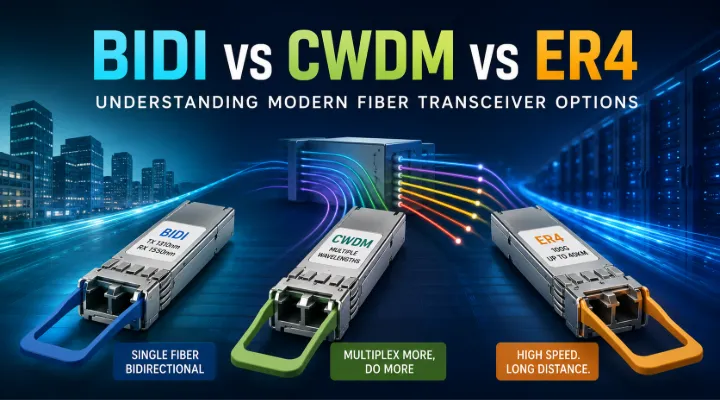
Fiber optic networks have become the backbone of modern communication. Whether connecting enterprise offices, cloud data centers, Internet Service Providers (ISPs), or campus networks, choosing the right fiber transceiver is essential for achieving reliable performance and controlling infrastructure costs.
Among the many available transceiver technologies, BIDI, CWDM, and ER4 are three of the most commonly discussed options. Although they all transmit data over fiber optic cables, they serve different purposes, support different distances, and require different network designs.
Understanding the differences between these technologies can help businesses avoid unnecessary expenses while ensuring their network delivers the required speed and reliability.
In this guide, we'll compare BIDI vs CWDM vs ER4, explain how each technology works, discuss their advantages and limitations, and help you determine which solution best fits your network.
What Is a Fiber Transceiver?
A fiber transceiver is a compact optical module that converts electrical signals into optical signals for transmission over fiber optic cables.
Common transceiver form factors include:
- SFP
- SFP+
- SFP28
- QSFP+
- QSFP28
- QSFP-DD
They are widely used in:
- Ethernet switches
- Routers
- Servers
- Storage systems
- Firewalls
- Optical transport equipment
The technology inside the transceiver determines:
- Supported speed
- Transmission distance
- Fiber type
- Wavelength
- Number of fibers required
Understanding BIDI Transceivers
What Does BIDI Mean?
BIDI (Bidirectional) transceivers allow two-way communication over a single strand of fiber instead of the traditional pair of fibers.
Instead of using one fiber for transmitting (TX) and another for receiving (RX), BIDI modules transmit and receive simultaneously using different wavelengths.
For example:
- Module A
- TX: 1310 nm
- RX: 1550 nm
- Module B
- TX: 1550 nm
- RX: 1310 nm
These complementary modules must always be installed as a matched pair.
How BIDI Works
BIDI uses Wavelength Division Multiplexing (WDM) technology.
Inside the module, an optical filter separates incoming and outgoing wavelengths, allowing both signals to travel over the same fiber simultaneously.
This effectively doubles fiber utilization without installing additional fiber cables.
Advantages of BIDI
Saves Fiber Infrastructure
Only one fiber strand is needed.
Ideal when spare fiber is unavailable.
Lower Installation Cost
Businesses avoid laying new fiber cables.
Easy Network Expansion
Existing fiber can support more connections.
Suitable for Campus Networks
Perfect for universities, hospitals, industrial facilities, and office campuses.
Limitations of BIDI
- Requires matched transceiver pairs
- Less flexible than traditional dual-fiber solutions
- Distance depends on module specification
- Not ideal for very high-capacity optical multiplexing
Typical BIDI Applications
- Enterprise campuses
- Building-to-building connections
- CCTV networks
- Metro Ethernet
- Industrial automation
- Government facilities
Understanding CWDM Transceivers
What Is CWDM?
CWDM (Coarse Wavelength Division Multiplexing) allows multiple optical signals to travel over the same fiber using different wavelengths.
Instead of sending one signal per fiber, CWDM can carry several independent channels simultaneously.
Common wavelengths include:
- 1270 nm
- 1290 nm
- 1310 nm
- 1330 nm
- 1350 nm
- 1370 nm
- 1390 nm
- 1410 nm
- 1430 nm
- 1450 nm
- 1470 nm
- 1490 nm
- 1510 nm
- 1530 nm
- 1550 nm
- 1570 nm
- 1590 nm
- 1610 nm
Each wavelength carries separate network traffic.
How CWDM Works
CWDM systems use:
- CWDM transceivers
- CWDM multiplexers
- CWDM demultiplexers
The multiplexer combines multiple wavelengths onto one fiber.
At the destination, the demultiplexer separates each wavelength back into individual connections.
Benefits of CWDM
Efficient Fiber Usage
Many connections share one fiber pair.
Scalable
Additional wavelengths can be added without replacing existing infrastructure.
Lower Cost Than DWDM
CWDM equipment is generally more affordable.
High Capacity
Supports multiple independent network services simultaneously.
Limitations
- Shorter reach compared to DWDM
- Limited wavelength count
- Requires multiplexing equipment
- More planning than standard Ethernet links
Common CWDM Applications
- Metropolitan Area Networks (MAN)
- ISP backbone networks
- University campuses
- Healthcare networks
- Enterprise inter-building links
- Data center interconnects
Understanding ER4 Transceivers
What Is ER4?
ER4 (Extended Reach 4-Lane) is a high-speed optical transceiver technology commonly found in 40G and 100G Ethernet networks.
The most common example is:
100G QSFP28 ER4
It supports transmission distances up to 40 kilometers over single-mode fiber.
How ER4 Works
ER4 uses four independent optical wavelengths.
Each wavelength carries approximately:
- 25 Gbps in 100G Ethernet
Together they provide:
25 × 4 = 100 Gbps
This technology uses LAN-WDM wavelengths to maximize bandwidth while maintaining long-distance communication.
Advantages of ER4
Long Distance
Supports up to 40 km.
High Bandwidth
Designed for 100 Gigabit networking.
Reliable Performance
Excellent signal quality over long fiber links.
Carrier-Grade Solution
Frequently used by telecom providers and cloud operators.
Limitations
- Higher cost
- Increased power consumption
- Requires high-quality single-mode fiber
- Mainly used for backbone infrastructure
Common ER4 Applications
- Cloud data centers
- Telecom providers
- Internet exchanges
- Financial institutions
- Government backbone networks
- Large enterprise WANs
BIDI vs CWDM vs ER4 Comparison
| Feature | BIDI | CWDM | ER4 |
|---|---|---|---|
| Fiber Required | Single fiber | Fiber pair with multiplexing | Single-mode fiber pair |
| Typical Speed | 1G–100G | Various | 40G/100G |
| Distance | Up to 80 km (model dependent) | Depends on module | Up to 40 km |
| Wavelengths | Two wavelengths | Multiple wavelengths | Four LAN-WDM wavelengths |
| Cost | Low to medium | Medium | Higher |
| Infrastructure Complexity | Low | Medium | Medium |
| Best For | Saving fiber | Increasing fiber capacity | High-speed long-distance links |
Choosing the Right Technology
Choose BIDI If
- Fiber availability is limited.
- Installing new fiber is expensive.
- You need a simple point-to-point connection.
- Budget is a priority.
Example:
A company connects two office buildings using only one available fiber strand.
Choose CWDM If
- Multiple network services share the same fiber.
- Fiber resources are limited.
- You want to maximize infrastructure utilization.
- Network expansion is expected.
Example:
A university connects multiple campus buildings over a metropolitan fiber network.
Choose ER4 If
- You require 100G connectivity.
- Links extend up to 40 km.
- High bandwidth is essential.
- You're building a data center backbone.
Example:
A cloud provider connects two data centers located 35 km apart.
Cost Considerations
The total project cost includes much more than the transceiver itself.
Consider:
- Fiber installation
- Optical modules
- Multiplexers (CWDM)
- Network switches
- Maintenance
- Future upgrades
Sometimes a slightly more expensive transceiver can significantly reduce fiber installation costs.
Deployment Tips
Before selecting any transceiver, evaluate:
- Required bandwidth
- Link distance
- Available fiber strands
- Future scalability
- Equipment compatibility
- Optical power budget
- Vendor support
- Warranty
Always verify compatibility with your networking equipment to avoid interoperability issues.
Real-World Examples
Enterprise Office
A business has only one unused fiber between two buildings.
Recommended: BIDI
Reason:
No additional fiber installation is required.
City-Wide ISP
An ISP needs multiple customer connections over limited fiber.
Recommended: CWDM
Reason:
Multiple wavelengths can share the same fiber infrastructure.
Large Data Center
Two facilities are connected over 38 km and require 100G throughput.
Recommended: ER4
Reason:
High-speed, long-distance connectivity with dependable performance.
Why Buy Fiber Transceivers from ICTECH Distribution?
Choosing the right supplier is just as important as choosing the right transceiver. ICTECH Distribution offers a wide selection of enterprise networking products from leading brands to support organizations of every size.
Benefits of working with ICTECH Distribution include:
- Extensive range of fiber transceivers and networking accessories
- Products from globally recognized manufacturers
- Support for enterprise, telecom, and data center deployments
- Competitive pricing for business customers
- Assistance in selecting compatible networking solutions
- Reliable service for businesses across the UAE and international markets
Whether you need BIDI modules for fiber optimization, CWDM solutions for higher network capacity, or ER4 transceivers for long-distance high-speed connectivity, ICTECH Distribution can help you find the right solution for your infrastructure.
Conclusion
BIDI, CWDM, and ER4 each solve different networking challenges, making them valuable tools in modern fiber optic deployments. BIDI is ideal for maximizing limited fiber resources with simple point-to-point links. CWDM enables multiple services to share the same fiber, improving scalability and infrastructure efficiency. ER4 is designed for demanding 100G long-distance connections where high bandwidth and reliability are essential.
There is no single "best" option for every environment. The right choice depends on your available fiber, required bandwidth, transmission distance, budget, and future growth plans. By understanding the strengths and limitations of each technology, organizations can build networks that are cost-effective, scalable, and ready to support evolving business needs.
Frequently Asked Questions
1. What is the main difference between BIDI, CWDM, and ER4?
BIDI uses a single fiber strand with two wavelengths for bidirectional communication, CWDM carries multiple independent signals over different wavelengths on the same fiber, and ER4 is a high-speed 40G/100G technology designed for long-distance transmission.
2. Can BIDI transceivers work with standard dual-fiber transceivers?
No. BIDI modules require complementary BIDI transceivers with matching transmit and receive wavelengths at each end of the link.
3. Is CWDM suitable for enterprise networks?
Yes. CWDM is widely used in enterprise campuses, metropolitan networks, healthcare organizations, universities, and service provider environments where fiber capacity needs to be increased.
4. When should I choose an ER4 transceiver?
ER4 is the right choice when you need 100G or 40G connectivity over long distances, typically up to 40 kilometers, such as between data centers or backbone network locations.
5. How do I select the right fiber transceiver?
Consider your required network speed, transmission distance, available fiber infrastructure, equipment compatibility, budget, and future expansion plans before selecting a transceiver.
