

Dell PowerEdge R960 Review: A Deep Dive into the 4U Flagship Server
In the ever-evolving landscape of enterprise IT, the demand for powerful, scalable, and versatile server solutions is paramount. Dell's PowerEdge R960, a 4U rack server, positions itself as a flagship offering designed to tackle the most demanding workloads, from artificial intelligence (AI) and machine learning (ML) to large-scale databases and high-performance computing (HPC). This review delves into its capabilities, exploring why it might be the cornerstone of your next data center upgrade.
At a Glance: Key Specifications
- Form Factor: 4U Rack Server
- Processors: Dual or Quad Socket, supporting 4th Generation Intel Xeon Scalable processors (Platinum and Gold families). Potential for future CPU upgrades.
- Memory: Massive footprint with up to 64 DDR5 RDIMM slots, supporting up to 16TB of memory.
- Storage: Highly flexible with numerous front-panel configurations, including SATA, SAS4, Gen4 NVMe, and the latest Gen5 NVMe EDSFF E3.S drives. Supports up to 24 x 2.5-inch drives or 16 x EDSFF E3.S drives.
- GPU Support: Accommodates up to 4x double-wide, 400W GPU accelerators.
- Expansion: Up to 12 PCIe 5.0 slots via multiple riser configurations.
- Networking: Optional OCP 3.0 mezzanine card and LOM (LAN on Motherboard) options.
- Management: Dell iDRAC9 (Express standard, Enterprise optional), OpenManage suite, Quick Sync 2.
- Power: Up to 4x 2400W or 2800W 80+ Platinum/Titanium redundant Power Supply Units (PSUs).
Design and Build: Engineered for Performance and Density
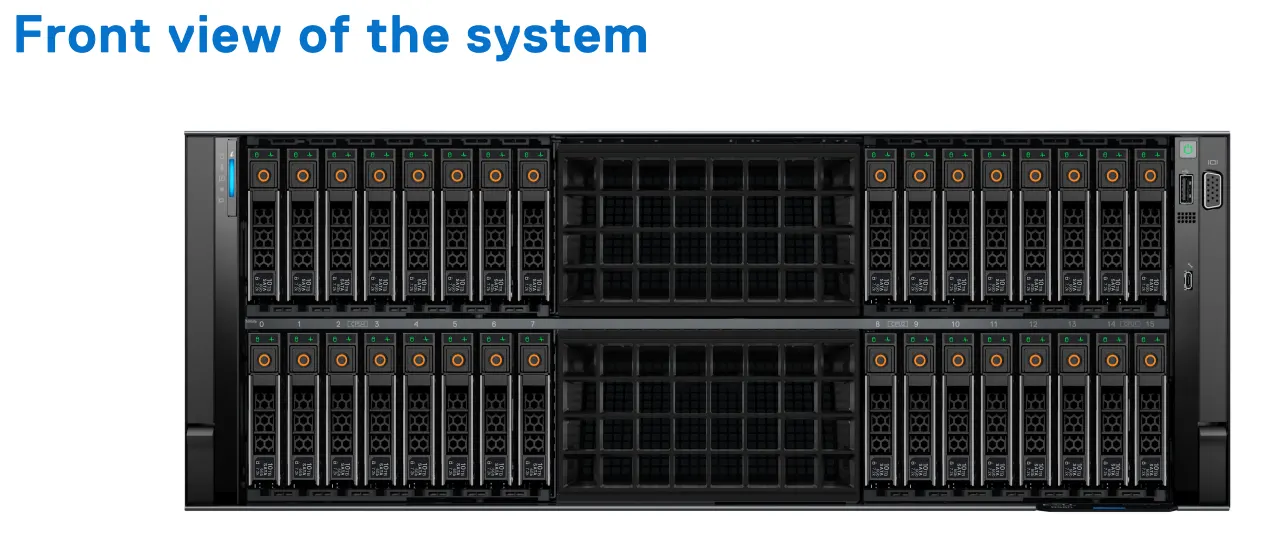
The Dell PowerEdge R960 impresses with its robust 4U chassis. The front panel, often adorned with an optional honeycomb bezel (available with or without a security lock and LED screen), provides access to a multitude of storage configurations. This flexibility is a key highlight, allowing businesses to tailor the server to specific storage needs, whether it's high-capacity SATA/SAS drives or ultra-fast NVMe solutions.
The introduction of EDSFF E3.S (Enterprise and Datacenter Standard Form Factor) drives is particularly noteworthy. These Gen5 NVMe drives are thinner than traditional U.2 drives, enabling better airflow for improved cooling, higher storage density, and enhanced performance due to increased power delivery capabilities. Even with configurations supporting up to 24 standard 2.5-inch NVMe Gen4 drives or 16 EDSFF E3.S drives, the front panel design cleverly leaves central sections open, likely aiding airflow.
The left control panel features essential system health and ID indicators, along with status LEDs for drives, temperature, electrical systems, memory, and PCIe. An optional Quick Sync 2 feature allows for at-chassis management via a mobile device using the Dell OpenManage Mobile app. The right server ear houses the power button, a USB 2.0 port, an iDRAC Direct Micro-AB USB port, and a VGA port for direct console access.
Compute Powerhouse: Processors, Memory, and GPUs
Under the hood, the R960 is built for serious computation. It supports either two or four 4th Generation Intel Xeon Scalable processors from the Platinum and Gold families. This offers substantial core counts (with CPUs ranging from 8 to 60 physical cores each, meaning up to 240 physical cores in a quad-CPU setup) and advanced features like 4x Ultra-Path Interconnect (UPI) links at 16GT/s and 80 PCIe 5.0 lanes per CPU. While currently on 4th Gen, the socket architecture could potentially accommodate future Intel CPU generations, offering an upgrade path.
Memory capacity is staggering. With 64 DDR5 RDIMM slots (32 per motherboard, 16 per CPU in a quad-CPU configuration), the R960 can be configured with up to 16TB of RAM using 256GB modules. Memory speeds can reach up to 5600MT/s (with 1 DIMM per channel), though this adjusts based on CPU, memory configuration, and modules (e.g., 4400MT/s with 2 DIMMs per channel).
For AI, ML, and graphics-intensive workloads, the R960 supports up to four double-wide, 400W GPU accelerators. This makes it a formidable platform for training complex models and running demanding analytics. The review unit showcased support for NVIDIA's Ampere architecture GPUs like the A800, A100, A16, and A40S. While newer architectures (Ada Lovelace, Blackwell) have since emerged, the 400W per slot capability positions it well for powerful GPU integration.
Storage Versatility: From Capacity to Blazing Speed
The R960 truly shines in its storage options:
- Front Bays: Support for SATA, SAS4, Gen4 NVMe U.2, and the newer, denser Gen5 NVMe EDSFF E3.S drives. Configurations can include up to 24x 2.5-inch NVMe Gen4 drives or up to 16x EDSFF E3.S (NVMe Gen5) drives.
- BOSS-N1: An optional Boot Optimized Storage Sub-system (BOSS-N1) card can be installed, supporting one or two M.2 NVMe SSDs specifically for booting the operating system. This frees up front drive bays for data and supports hardware RAID 0 or 1 for redundancy.
- RAID Controllers: A range of PERC (PowerEdge RAID Controller) cards are available for internal SAS/SATA storage, and HBAs can be added for external storage connectivity (e.g., to PowerVault ME5 series). The system also offers an S160 software RAID option via the CPU.
Connectivity and Expansion: Future-Proof I/O
The rear of the R960 is as configurable as its front. Several chassis backplane options exist (Basic, Scale-out, Maximum I/O, and one with optional liquid cooling connections).
Standard rear I/O includes:
- Unit ID button and LED
- Dedicated RJ45 iDRAC management port
- USB 2.0 port
- USB 3.0 port
- VGA port
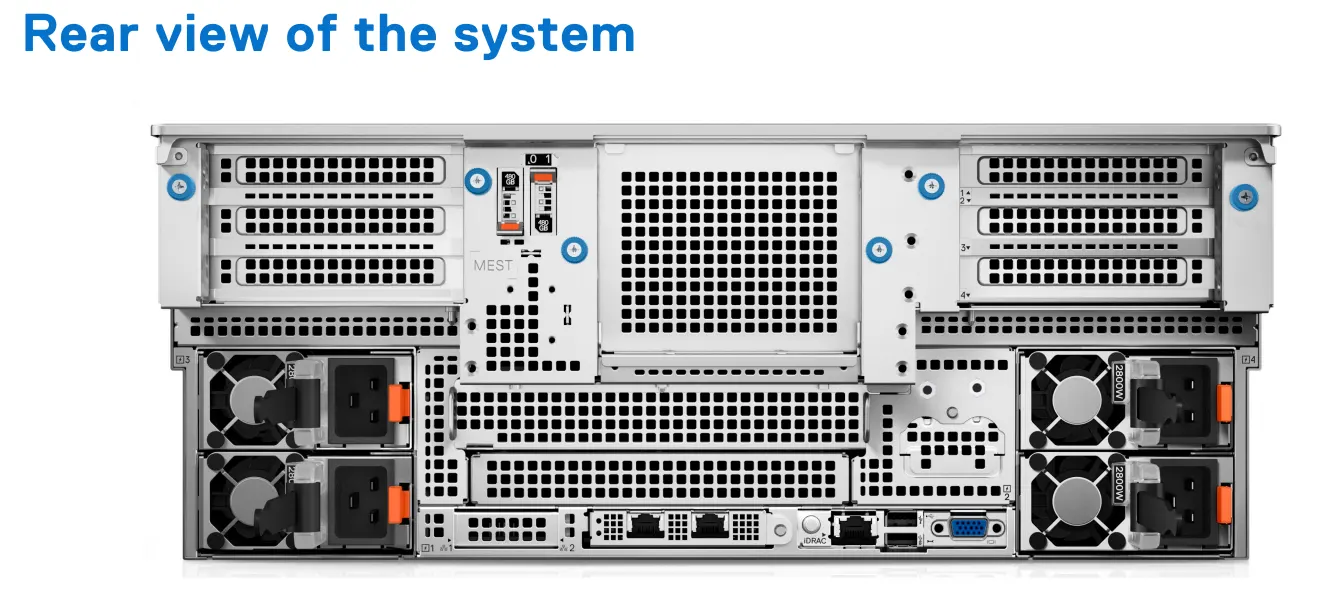
An OCP 3.0 (Open Compute Project) mezzanine card slot provides flexible networking options, with cards offering various speeds (e.g., dual-port 25GbE SFP28, up to dual-port 100Gb/s). There's also an optional LOM (LAN on Motherboard) card slot.
Across the various riser configurations, the R960 can provide up to 12 PCIe 5.0 slots, ensuring ample bandwidth for high-speed network cards, HBAs, and other expansion cards.
Power and Cooling: Robust and Resilient
To power this beast, the R960 supports up to four hot-swappable PSUs, typically 2400W 80+ Platinum units in a 2+2 redundancy configuration for 100-240V systems. For extremely dense configurations with multiple high-power GPUs and drives, 2800W PSUs are available. These high-wattage PSUs necessitate the use of thicker C21 power cables, which are more heat-resistant than standard C19 cables, handling temperatures up to 155°C.
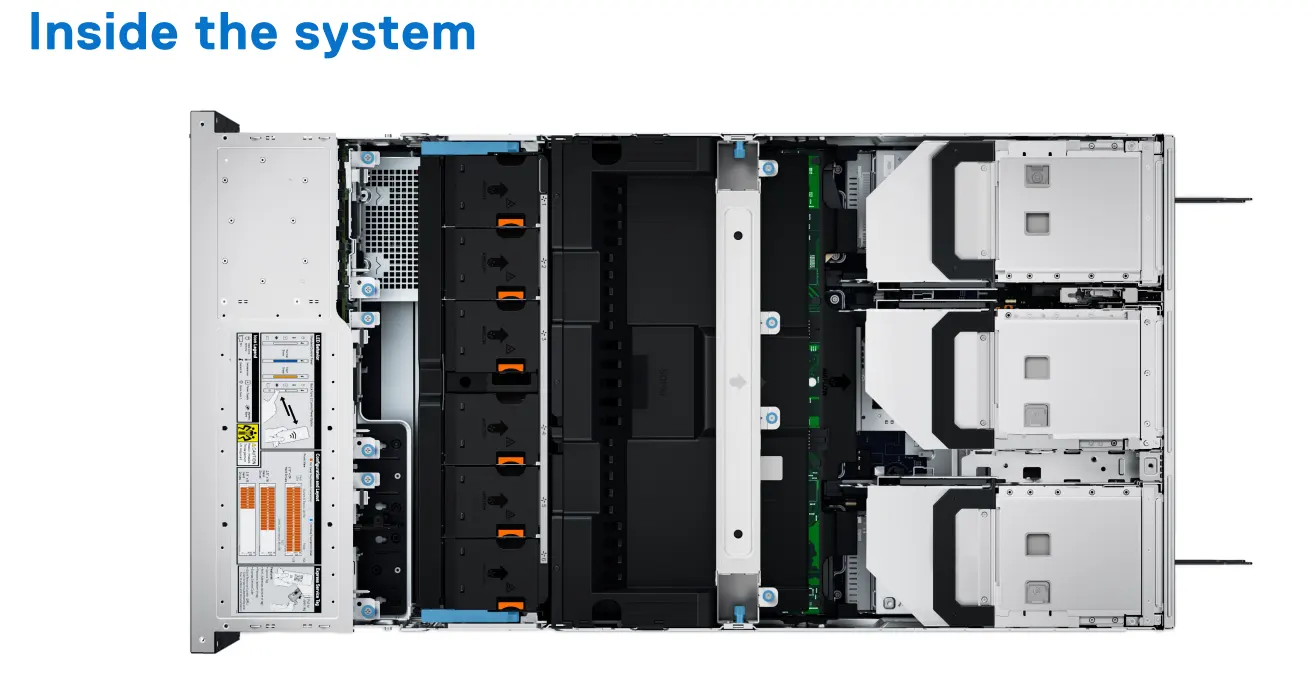
Cooling is managed by numerous sensors throughout the chassis that dynamically adjust fan speeds. The internal layout, especially with the GPU shroud, is designed to optimize airflow. For extreme thermal loads, an optional liquid cooling configuration is available, which replaces the rear VGA port on the lower motherboard's I/O panel with an inlet/outlet for coolant tubes. High-performance, low-profile L-shaped heatsinks are used on the CPUs. Dell’s Enterprise Infrastructure Planning Tool (EIPT) can help calculate power consumption and PSU needs based on your specific configuration.
Comprehensive Management
Dell provides a robust suite of management tools:
- iDRAC9: The integrated Dell Remote Access Controller 9 (iDRAC9) comes with Express licensing as standard, offering comprehensive remote management capabilities. An upgrade to iDRAC9 Enterprise unlocks advanced features.
- Dell OpenManage Suite: This portfolio includes tools for deployment, updates, monitoring, and maintenance, such as OpenManage Enterprise, CloudIQ for PowerEdge, and integrations with VMware vCenter and Microsoft System Center.
- Quick Sync 2: An optional feature enabling secure at-the-server management via Bluetooth Low Energy (BLE) using a smartphone or tablet running the OpenManage Mobile app (iOS and Android).
- iDRAC Direct Port: A Micro-AB USB port on the front right ear allows direct laptop connection for local iDRAC management.
Ideal Use Cases
The Dell PowerEdge R960 is engineered for:
- AI, Machine Learning, and Deep Learning: Thanks to its powerful CPU and extensive GPU support.
- Large In-Memory Databases: Ideal for SAP HANA, SQL Server, Oracle, with its massive memory capacity.
- High-Performance Computing (HPC) Clusters: For scientific research, simulations, and complex calculations.
- Data Warehousing and Analytics: Processing and analyzing vast datasets.
- Dense Virtualization Environments: Running a high number of virtual machines efficiently.
Conclusion: A Versatile Powerhouse for Modern Data Centers
The Dell PowerEdge R960 is a testament to Dell's commitment to high-performance enterprise computing. Its exceptional flexibility in CPU, memory, storage, GPU, and I/O configurations allows businesses to precisely tailor the system to their most demanding and evolving workloads. With robust power, cooling, and comprehensive management features, the R960 stands as a formidable 4U rack server ready to anchor critical applications and drive innovation.
Looking to harness the power of the Dell PowerEdge R960 for your enterprise?
At ICTECH Distribution, we are a dynamic force in IT distribution, headquartered in Dubai. Our core mission is to distribute IT products globally with high volume and the best prices. Specializing in an extensive range of IT solutions, including Dell servers, we cater to businesses and individuals around the world. As a leading Dell server distributor in the UAE and a trusted Dell server supplier in Dubai, we take pride in providing high-volume stocks, the best prices, and an unparalleled sales team dedicated to your success.
Contact ICTECH Distribution today to discuss your Dell PowerEdge R960 requirements and explore our comprehensive IT solutions. Let us be your partner in building a powerful and scalable IT infrastructure.
