
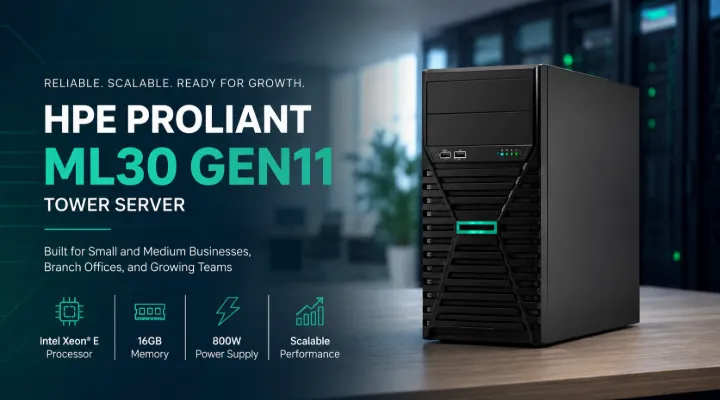
Businesses depend on reliable IT infrastructure for everyday operations. File sharing, databases, business applications, backups, virtualization, and internal services all require a platform that can deliver dependable performance without introducing unnecessary complexity or cost.
The HPE ProLiant ML30 Gen11 P65096-421 is a tower server designed to meet these requirements. Powered by an Intel Xeon E processor and equipped with 16GB RAM and an 800W power supply, it provides a practical foundation for small and medium-sized business environments.
Unlike compact rack servers, the ML30 Gen11 uses a tower form factor that can be convenient for offices and locations where a dedicated server rack is not available. It also provides room for expansion, allowing businesses to increase storage or memory as their requirements develop.
In this article, we look at the key characteristics of the HPE ProLiant ML30 Gen11 and how businesses can use it in real-world environments.
What Is the HPE ProLiant ML30 Gen11?
The HPE ProLiant ML30 Gen11 is a compact tower server from HPE's ProLiant Gen11 family. It is designed primarily for small businesses, branch offices, remote locations, and organizations that need dedicated server hardware without deploying a large data-center server.
The ML30 Gen11 can support a range of common workloads, including:
- File and document sharing
- Business applications
- Database workloads
- Virtualization
- Web applications
- Backup services
- Print and network services
- Collaboration applications
- Small office infrastructure
The tower design also makes it easier to position the server in an office, server room, or branch location.
Key Specifications of the P65096-421
The P65096-421 configuration provides a balanced starting point for organizations that need dependable server hardware.
| Specification | Details |
|---|---|
| Server | HPE ProLiant ML30 Gen11 |
| Part Number | P65096-421 |
| Form Factor | Tower |
| Processor | Intel Xeon E |
| Memory | 16GB RAM |
| Power Supply | 800W |
| Server Generation | HPE ProLiant Gen11 |
The exact storage and expansion configuration should be checked against the specific product quotation before purchase, as server configurations can vary by region and SKU.
Intel Xeon E Performance for Business Applications
The Intel Xeon E processor family is designed for reliable server and workstation-class workloads. For a small organization, the processor provides a suitable foundation for everyday applications that need consistent performance.
For example, a company with 20 employees might use the server for centralized file storage, user authentication, a small database, and internal business applications. Instead of running these services across several individual computers, they can be consolidated onto a dedicated server.
This can simplify administration and make it easier for an IT administrator to manage business resources from one central location.
The processor is particularly appropriate for environments where reliability and predictable performance are more important than extremely high computational throughput.
16GB RAM for Everyday Server Workloads
The P65096-421 configuration includes 16GB of RAM, providing a useful starting point for many small business applications.
Memory requirements depend heavily on how the server will be used. A file server with a relatively small number of users may require considerably less memory than a server running multiple virtual machines.
For example:
- A small company uses the server for file sharing and printing.
- A database application is added later.
- A backup application is deployed.
- The organization eventually introduces a virtual machine for another business application.
As workloads increase, memory expansion can help maintain performance. This makes it important to consider not only today's requirements but also potential future needs when planning a server deployment.
Storage and Expansion
Storage is one of the most important considerations when purchasing a business server. The required capacity depends on the type and volume of data being generated.
A business handling mostly office documents may need relatively modest storage. In contrast, companies working with engineering files, media, databases, surveillance recordings, or large project files may require significantly more capacity.
The ML30 Gen11's tower architecture provides a practical platform for storage expansion, depending on the selected drive and controller configuration.
Businesses should consider:
- Current storage requirements
- Expected annual data growth
- Backup capacity
- Redundancy requirements
- SSD versus HDD requirements
- Application performance requirements
For example, a company currently storing 2TB of business data should not necessarily purchase a server with exactly 2TB of usable storage. Future growth and backup requirements should be included in the planning process.
Why Choose a Tower Server?
Tower servers remain useful even as rack-mounted infrastructure becomes common in larger data centers.
The ML30 Gen11 can be particularly practical for organizations that do not operate a dedicated server room.
Office-Friendly Deployment
A tower server can be installed in an appropriate office or equipment room without requiring a standard rack cabinet.
Suitable for Small Businesses
Organizations with a limited number of users may not need the scale of a large rack server.
Easier Infrastructure Planning
A tower server can provide a straightforward starting point for companies moving from desktop-based or improvised server infrastructure to a dedicated IT environment.
Room for Growth
Expansion capabilities can allow the business to increase resources as workloads grow, rather than replacing the entire server immediately.
Practical Use Cases
1. File Server
A business can use the ML30 Gen11 as a centralized file server. Employees can access shared documents from a controlled location rather than storing important files across individual PCs.
This can also make backup management easier.
2. Small Database Server
Organizations running accounting, inventory, ERP, CRM, or other business applications can use a dedicated server to host their database environment.
For example, a distributor with several sales and warehouse employees could centralize inventory and order information on the server.
3. Virtualization
The server can also serve as a platform for virtualization, depending on the selected operating system, processor, memory, storage, and workload requirements.
Instead of dedicating separate physical machines to lightweight applications, a business may run multiple virtual machines on one physical server.
4. Branch Office Infrastructure
A company with several locations may need local IT resources at each branch.
The ML30 Gen11's tower design makes it suitable for environments where a compact, rack-mounted infrastructure is unnecessary.
5. Backup Server
Businesses can use dedicated server hardware as part of a backup strategy. Centralizing backup data can help administrators manage scheduled backups and recovery processes more efficiently.
However, organizations should remember that a server itself is not a complete backup strategy. Important data should ideally have additional copies stored separately.
Security and Management
Modern business servers need more than processing power and storage. Security and manageability are equally important.
HPE ProLiant Gen11 servers are designed with enterprise-focused management and security capabilities intended to help organizations maintain and manage their infrastructure.
For IT teams, centralized server management can reduce the time required for routine administration and troubleshooting.
Security should also be considered throughout the deployment process. Businesses should implement appropriate:
- User access controls
- Operating system security
- Network protection
- Regular updates
- Backup policies
- Monitoring
- Physical security
Hardware security features are most effective when combined with sound IT policies and operational practices.
HPE ProLiant ML30 Gen11 vs. a Regular Desktop PC
A common question for small businesses is whether they should use a high-end desktop instead of a dedicated server.
While a desktop may appear cheaper initially, a server is designed specifically for continuous business workloads.
A dedicated server can offer advantages such as:
- Server-oriented hardware
- Greater expansion potential
- Centralized storage
- Better suitability for multiple users
- Enterprise-focused management features
- Support for server operating systems
- Easier infrastructure scaling
For example, a five-person company might initially manage shared files using a desktop PC. As the company grows to 20 or 30 employees, centralized server infrastructure becomes much more practical.
Things to Consider Before Buying
Before purchasing the HPE ProLiant ML30 Gen11 P65096-421, businesses should evaluate their actual workload.
Consider Your User Count
Estimate how many users will access the server simultaneously.
Plan Storage Carefully
Calculate current data requirements and expected growth rather than focusing only on today's capacity.
Evaluate Memory Requirements
16GB can be a good starting configuration, but virtualization and memory-intensive applications may require additional RAM.
Consider Redundancy
For critical workloads, evaluate RAID, backup, redundant components, and recovery procedures according to business requirements.
Check Operating System Compatibility
Confirm that the intended Windows Server, Linux distribution, virtualization platform, or business application is supported by the selected hardware configuration.
Why the ML30 Gen11 Can Be a Good Business Investment
The biggest advantage of the HPE ProLiant ML30 Gen11 is its balance between capability and practical deployment.
A small organization does not always need a large multi-processor rack server. Instead, it may need a dependable system that can support today's applications while leaving room for future expansion.
The ML30 Gen11 provides that type of foundation. Its tower form factor, Intel Xeon E processor, 16GB memory configuration, and 800W power supply make it suitable for a variety of small and medium business environments.
At ICTECH Distribution, businesses can explore server configurations based on their workload, storage requirements, expansion plans, and deployment environment.
Conclusion
The HPE ProLiant ML30 Gen11 P65096-421 is a practical tower server for businesses that need dedicated infrastructure without the complexity of a large data-center deployment.
With an Intel Xeon E processor, 16GB RAM, and an 800W power supply, it provides a solid starting point for file sharing, databases, business applications, virtualization, backup services, and branch-office workloads.
Its expandable tower design also makes it suitable for organizations expecting their IT requirements to grow over time. The key is to select the right storage, memory, operating system, and redundancy configuration based on the intended workload.
For small and medium-sized businesses looking for a reliable server platform, the ML30 Gen11 is worth considering as part of a scalable IT infrastructure strategy.
Frequently Asked Questions
1. What is the HPE ProLiant ML30 Gen11 used for?
The ML30 Gen11 is designed for small and medium business workloads such as file sharing, databases, business applications, virtualization, backup services, and branch-office infrastructure.
2. How much RAM does the P65096-421 have?
The HPE ProLiant ML30 Gen11 P65096-421 configuration listed here comes with 16GB of RAM. Memory requirements can vary depending on the applications and virtualization workloads being used.
3. Is the ML30 Gen11 suitable for a small business?
Yes. Its tower design and server-oriented hardware make it suitable for many small businesses, branch offices, and organizations that need centralized IT resources.
4. Can the HPE ML30 Gen11 be used for virtualization?
It can be used for virtualization when the processor, memory, storage, operating system, and virtualization platform are appropriately configured for the intended workload.
5. Why choose a tower server instead of a rack server?
A tower server can be easier to deploy in smaller offices and locations without a dedicated server rack. It can provide useful expansion capabilities while keeping the infrastructure relatively simple.
