
Businesses increasingly need server infrastructure that can deliver reliable performance without taking up excessive space. For small and medium-sized businesses, branch offices, remote sites, and organizations with limited rack space, a compact server can provide an excellent balance between performance, manageability, scalability, and cost.
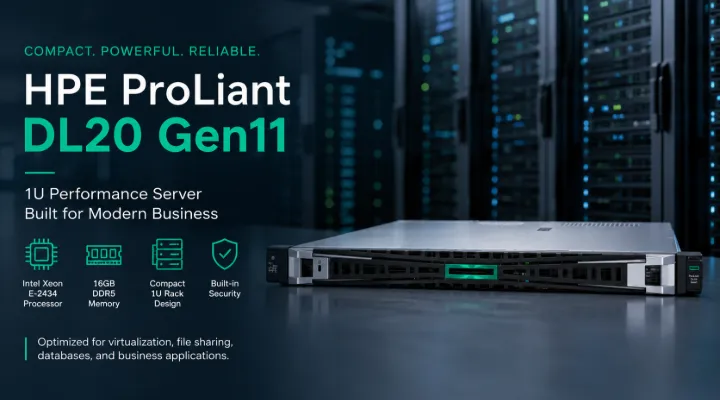
The HPE ProLiant DL20 Gen11 P65394-421 is a 1U rackmount server designed for organizations that need dependable computing infrastructure in a compact form factor. Powered by an Intel Xeon E-2434 processor and equipped with 16GB of RAM, this server provides a practical foundation for workloads such as file sharing, web applications, business applications, virtualization, and infrastructure services.
As part of the HPE ProLiant Gen11 family, the DL20 Gen11 also benefits from HPE's focus on security, remote management, performance, and operational efficiency.
In this guide, we look at the key characteristics of the HPE ProLiant DL20 Gen11 P65394-421, its potential applications, and why a compact 1U server can be a valuable choice for growing businesses.
HPE ProLiant DL20 Gen11 P65394-421 at a Glance
The P65394-421 configuration combines a compact chassis with an Intel Xeon processor and enterprise-oriented server features.
Key specifications include:
- Server: HPE ProLiant DL20 Gen11
- Part number: P65394-421
- Processor: Intel Xeon E-2434
- Processor frequency: 3.4 GHz
- Memory: 16GB RAM
- Form factor: 1U rackmount
- Product family: HPE ProLiant Gen11
- Intended environment: Business and enterprise IT infrastructure
The combination makes the DL20 Gen11 particularly suitable where rack space is limited but a business still requires dedicated server hardware.
What Makes the HPE ProLiant DL20 Gen11 Different?
Compact 1U Rack Design
One of the most important advantages of the DL20 Gen11 is its 1U form factor.
A 1U server is designed to occupy only one rack unit in a standard server rack. This allows businesses to install more equipment within the same rack compared with larger 2U or 4U systems.
For example, a company operating a small server room may need separate systems for applications, file services, networking, and backup. Using compact servers can make better use of the available rack space.
The DL20 Gen11 can therefore be particularly useful for:
- Small server rooms
- Branch offices
- Retail locations
- Remote business sites
- Dedicated application servers
- Space-constrained data centers
Intel Xeon E-2434 Processor
The HPE ProLiant DL20 Gen11 P65394-421 is equipped with an Intel Xeon E-2434 processor running at 3.4 GHz.
Intel Xeon processors are designed for professional and server environments where reliability and consistent operation are important. The Xeon E-2434 provides a suitable processing platform for a variety of business workloads.
Depending on the overall system configuration and software requirements, organizations can use this type of server for applications such as:
- Business software
- File and print services
- Web applications
- Database workloads
- Infrastructure management
- Development environments
- Selected virtualization workloads
The processor is particularly well suited to organizations that need a dedicated server without moving to a much larger enterprise platform.
16GB RAM for Business Applications
The P65394-421 configuration comes with 16GB of RAM.
Memory requirements vary significantly depending on the applications running on a server. A basic file server may have very different requirements from a database server or virtualization host.
With 16GB installed, the DL20 Gen11 provides a practical starting point for many small-business server applications. Organizations can also evaluate memory expansion options based on their workload requirements and the supported system configuration.
For example, a small business could use the server for centralized file storage and business applications while keeping separate systems for high-performance database or virtualization workloads.
When planning a server purchase, it is important to consider both current requirements and expected growth rather than selecting hardware based solely on today's workload.
Common Applications of the HPE ProLiant DL20 Gen11
1. File and Print Services
One of the simplest applications for a business server is centralized file management.
Instead of keeping important documents across multiple employee computers, businesses can use a dedicated server to provide centralized access to files and shared resources.
This can help organizations improve:
- File organization
- Centralized access
- User management
- Backup processes
- Internal collaboration
The DL20 Gen11's compact rackmount design makes it suitable for offices where dedicated server hardware is required but physical space is limited.
2. Web Applications
Businesses running internal or customer-facing web applications may require a dedicated server environment.
The DL20 Gen11 can serve as a platform for selected web workloads, depending on the application's processor, memory, storage, operating system, and software requirements.
For example, a company could deploy an internal employee portal, business application, or development environment on a dedicated server.
3. Database Services
Databases are central to many business applications, including ERP, CRM, inventory, accounting, and internal management systems.
A server such as the DL20 Gen11 can be considered for smaller or appropriately sized database workloads.
However, database performance depends on several components, not just the processor. Storage performance, memory capacity, database optimization, network connectivity, and workload size should all be evaluated before deployment.
4. Virtualization
Server virtualization allows organizations to run multiple virtual machines on a single physical server.
For a small business, this can be useful when several lightweight services need to run independently. For example, one physical server could potentially host separate virtual machines for:
- A domain controller
- A file server
- An internal application
- A monitoring system
The actual number of virtual machines that can be supported depends on resource requirements and the selected virtualization platform.
For larger virtualization environments, organizations may require servers with significantly more CPU cores, memory, storage, and expansion capacity.
5. Branch Office Infrastructure
The DL20 Gen11 can also be considered for branch-office deployments.
A branch office may need local computing resources for applications, file services, authentication, monitoring, or other infrastructure tasks. A compact 1U server makes it possible to deploy these services without requiring a large equipment footprint.
This is especially useful when standard rack infrastructure is available but space is limited.
Why Gen11 Matters
The HPE ProLiant Gen11 generation represents a newer generation of HPE server infrastructure designed around modern computing, management, security, and workload requirements.
For businesses, choosing a current-generation server can provide a stronger foundation for future infrastructure planning compared with purchasing older hardware solely because it has a lower initial price.
A modern server platform can also make it easier for IT teams to standardize hardware across new deployments.
Security and Server Management
Security is an increasingly important consideration when deploying business infrastructure.
Servers often contain sensitive information, support critical applications, and provide access to important organizational resources. As a result, hardware security and management capabilities are important parts of modern server infrastructure.
HPE ProLiant servers are designed with security and management as key considerations. HPE's server ecosystem includes tools and technologies intended to help IT administrators monitor, configure, maintain, and secure infrastructure.
For organizations, this can help simplify routine server administration and reduce the operational burden associated with managing physical infrastructure.
However, server security should always be treated as a complete process. Organizations should also implement:
- Strong administrator authentication
- Regular operating system updates
- Application patching
- Network security controls
- Backup and recovery procedures
- User access controls
- Monitoring and logging
Hardware security features are most effective when combined with good IT security practices.
Why Choose a 1U Server?
A common question when selecting server hardware is whether a 1U system is sufficient or whether a larger server should be purchased.
The answer depends on the workload.
A 1U server can be an excellent choice when:
- Rack space is limited
- The workload does not require extensive expansion
- The organization needs a dedicated physical server
- Power and physical footprint need to be controlled
- The server will operate as part of a larger infrastructure
A larger 2U or 4U server may be more appropriate when an organization requires extensive storage capacity, additional expansion cards, large numbers of drives, or very high memory capacity.
For many smaller installations, however, a compact server can provide a practical balance between capability and physical size.
HPE ProLiant DL20 Gen11 for Small and Medium-Sized Businesses
Small and medium-sized businesses often have different requirements from large enterprise data centers.
They may need reliable infrastructure but have:
- Limited IT budgets
- Smaller server rooms
- Fewer IT personnel
- Lower overall workloads
- A need for straightforward management
- Plans for gradual growth
The HPE ProLiant DL20 Gen11 can fit into this environment because it provides dedicated server hardware in a compact form factor.
For example, consider a growing professional services company with 40 employees. It may require centralized file services, authentication, a business application, and internal web tools. Instead of purchasing a large enterprise server with considerably more capacity than required, the company could evaluate a compact server platform appropriate to its actual workload.
Things to Consider Before Buying
Although the DL20 Gen11 P65394-421 is a capable compact server, buyers should evaluate their requirements before placing an order.
Workload Requirements
Determine what applications will run on the server and how many users will access them.
A server for a small file-sharing environment has very different requirements from a server supporting a large database.
Memory Requirements
The supplied 16GB RAM may be suitable for certain workloads, but memory requirements can increase as applications and user numbers grow.
Check the supported memory configuration and expansion options before purchasing.
Storage
Storage is another important consideration.
Businesses should evaluate:
- Required capacity
- Drive type
- Performance requirements
- RAID requirements
- Backup requirements
- Expected data growth
A server should never be designed around capacity alone. Data protection and recovery should also be considered.
Networking
The server's network configuration should match the organization's infrastructure.
Businesses should consider network speed, switch compatibility, redundancy requirements, VLAN design, and the expected volume of traffic.
Operating System and Software
The hardware should be compatible with the operating system, virtualization platform, database, or business software that the organization intends to deploy.
It is advisable to check software and hardware compatibility before finalizing the configuration.
HPE ProLiant DL20 Gen11 vs. Desktop-Class Hardware
Some small businesses consider using a powerful desktop PC as a server because it may appear less expensive.
However, a dedicated rack server is designed specifically for continuous business operation and infrastructure environments.
A purpose-built server can provide advantages such as:
- Rackmount installation
- Enterprise-oriented management
- Server-focused hardware design
- Better integration with professional infrastructure
- Easier standardization
- Greater suitability for continuous operation
A desktop computer can be appropriate for certain light-duty applications, but businesses relying on important services should carefully consider the advantages of dedicated server hardware.
Why Buy the HPE ProLiant DL20 Gen11 P65394-421 from ICTECH Distribution?
Choosing the right server is only one part of an infrastructure project. Businesses also need a reliable source for genuine hardware, configuration guidance, availability, and commercial support.
ICTECH Distribution provides IT hardware solutions for businesses and organizations looking for professional infrastructure products.
The HPE ProLiant DL20 Gen11 P65394-421 is available through ICTECH Distribution for customers evaluating compact HPE server solutions.
You can learn more about the HPE ProLiant DL20 Gen11 P65394-421 server and review the available product information.
For businesses with specific workloads, it is also useful to discuss processor requirements, memory, storage, operating system compatibility, and future expansion before selecting a configuration.
Conclusion
The HPE ProLiant DL20 Gen11 P65394-421 is a compact 1U rack server designed for organizations that need dependable computing infrastructure without consuming significant rack space.
With an Intel Xeon E-2434 processor, 16GB of RAM, and the HPE ProLiant Gen11 platform, it provides a practical foundation for a range of business workloads, including file services, web applications, selected database workloads, infrastructure services, and appropriately sized virtualization environments.
Its compact design makes it particularly attractive to small and medium-sized businesses, branch offices, and organizations operating in space-constrained server rooms.
The most important consideration is matching the server configuration to the actual workload. Businesses should evaluate memory, storage, networking, software compatibility, scalability, and backup requirements before deployment.
For organizations looking for a professional rackmount server in a compact form factor, the HPE ProLiant DL20 Gen11 P65394-421 is a solution worth considering.
Frequently Asked Questions
1. What processor does the HPE ProLiant DL20 Gen11 P65394-421 use?
The P65394-421 configuration uses an Intel Xeon E-2434 processor with a 3.4 GHz frequency. It is designed for professional server and business computing workloads.
2. How much RAM does the HPE ProLiant DL20 Gen11 P65394-421 have?
This configuration comes with 16GB of RAM. Depending on the workload and supported configuration, organizations can evaluate additional memory requirements before deployment.
3. Is the HPE ProLiant DL20 Gen11 suitable for small businesses?
Yes. Its compact 1U rackmount design and server-oriented platform make it suitable for many small and medium-sized business environments, branch offices, and dedicated infrastructure applications.
4. Can the DL20 Gen11 be used for virtualization?
It can be considered for appropriately sized virtualization workloads. The number and type of virtual machines that can run effectively will depend on processor, memory, storage, software, and workload requirements.
5. Why choose a 1U rack server?
A 1U rack server occupies relatively little rack space while providing dedicated server infrastructure. This makes it useful for businesses and data centers where space efficiency is important.
