
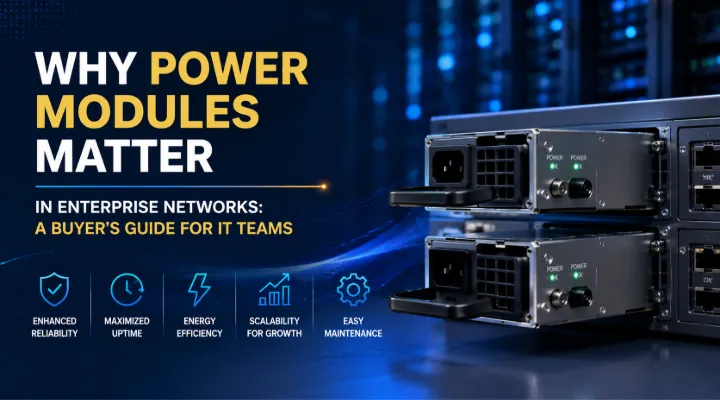
When organizations invest in network infrastructure, attention often focuses on switches, routers, firewalls, wireless access points, and optical transceivers. However, one critical component that is frequently overlooked is the power module.
Power modules serve as the backbone of network equipment by providing stable and reliable power to essential devices. Whether deployed in enterprise campuses, data centers, telecom facilities, or branch offices, power modules directly impact network availability, reliability, and business continuity.
A network is only as reliable as its power source. Even the most advanced networking hardware cannot function effectively if power delivery is unstable or insufficient. For IT teams and ICT buyers, understanding the importance of power modules is essential when planning infrastructure upgrades or building resilient enterprise networks.
This guide explains why power modules matter, how they work, the different types available, and what buyers should consider before making a purchase.
Who Should Read This Guide?
This article is designed for:
- ICT buyers
- IT managers
- Network administrators
- Data center operators
- System integrators
- Enterprise infrastructure planners
- Procurement teams
- Telecom professionals
If you are responsible for network performance, uptime, or infrastructure purchasing, understanding power modules can help you make better investment decisions.
What Is a Power Module?
A power module is a hardware component that supplies electrical power to networking equipment and IT infrastructure devices.
Power modules are commonly found in:
- Network switches
- Enterprise routers
- Firewalls
- Data center switches
- Storage systems
- Servers
- Telecom equipment
- Wireless controllers
Their primary role is to convert incoming electrical power into the voltage and current required by the equipment.
Without a properly functioning power module, network devices cannot operate.
Why Power Modules Are Critical in Enterprise Networks
Ensuring Continuous Network Availability
Modern businesses rely heavily on network connectivity.
Applications such as:
- Cloud computing
- Video conferencing
- ERP systems
- Customer service platforms
- Financial applications
- E-commerce systems
all depend on uninterrupted network access.
A failed power module can bring critical network equipment offline, causing downtime and operational disruptions.
Reliable power modules help ensure continuous operation even during demanding workloads.
Supporting Business Continuity
Downtime can be expensive.
According to industry studies, network outages can result in:
- Lost productivity
- Missed sales opportunities
- Customer dissatisfaction
- Service disruptions
- Compliance risks
Redundant power modules help organizations maintain business continuity by providing backup power in case of failure.
Protecting Network Investments
Enterprise networking equipment often represents a significant capital investment.
Power modules help protect that investment by:
- Delivering stable power
- Preventing voltage fluctuations
- Reducing hardware stress
- Improving equipment lifespan
Consistent power delivery contributes to better long-term performance and reliability.
How Power Modules Work
Power modules convert incoming AC or DC electricity into the specific voltage required by network equipment.
The process typically involves:
- Receiving incoming power
- Converting voltage levels
- Regulating current flow
- Delivering stable output
- Protecting against electrical fluctuations
Advanced power modules also include monitoring capabilities that help IT teams identify issues before they affect operations.
Types of Power Modules Used in Enterprise Networks
AC Power Modules
AC power modules use alternating current supplied from standard electrical outlets.
Common Applications
- Enterprise offices
- Campus networks
- Branch locations
- Data centers
Advantages
- Easy deployment
- Widely available power source
- Lower installation complexity
AC power modules are among the most commonly deployed options in enterprise environments.
DC Power Modules
DC power modules use direct current power sources.
Common Applications
- Telecommunications facilities
- Service provider networks
- Industrial environments
- Critical infrastructure
Advantages
- High reliability
- Improved efficiency
- Better suitability for telecom systems
Many telecom operators prefer DC-powered infrastructure because of its stability and resilience.
Redundant Power Modules
Redundant power modules provide backup power capability.
When one module fails, another immediately takes over.
Benefits
- Improved uptime
- Reduced service interruptions
- Enhanced business continuity
- Increased reliability
Redundancy is especially important for mission-critical environments.
Hot-Swappable Power Modules
Hot-swappable modules allow replacement without shutting down equipment.
Benefits
- Reduced maintenance downtime
- Faster repairs
- Continuous operation
This feature is particularly valuable in data centers and enterprise core networks.
Why Redundant Power Supplies Matter
Understanding Single Points of Failure
A single power supply creates a potential point of failure.
If the module fails:
- The device shuts down
- Services become unavailable
- Users experience interruptions
Redundant power modules eliminate this risk by providing backup power capacity.
Example: Core Network Switch
Imagine an enterprise headquarters with a core switch supporting:
- Internet access
- Voice systems
- Security services
- Branch connectivity
If the primary power module fails and no backup exists, the entire network could become unavailable.
With dual power modules installed:
- The secondary module takes over instantly
- Users remain connected
- Operations continue uninterrupted
Benefits of Modern Enterprise Power Modules
Improved Energy Efficiency
Today's power modules are designed to minimize energy waste.
Benefits include:
- Reduced electricity consumption
- Lower cooling requirements
- Improved sustainability
- Reduced operational expenses
This is particularly important in large data centers.
Enhanced Monitoring and Management
Many modern power modules include intelligent monitoring capabilities.
IT teams can track:
- Power consumption
- Temperature
- Voltage levels
- Power supply health
- System alerts
This visibility improves proactive maintenance and reduces unexpected failures.
Better Reliability
Enterprise-grade power modules undergo extensive testing to ensure:
- Stable operation
- Long service life
- Consistent performance
- Environmental resilience
Reliable power delivery is essential for business-critical systems.
Scalability for Growing Networks
As organizations expand, power requirements increase.
Modern power modules support:
- Higher-capacity devices
- Additional network hardware
- Future upgrades
This scalability helps organizations avoid costly infrastructure redesigns.
Power Modules in Different Network Environments
Enterprise Campus Networks
In campus environments, power modules support:
- Core switches
- Distribution switches
- Wireless infrastructure
- Security systems
Reliable power ensures uninterrupted access for employees and users.
Data Centers
Data centers demand extremely high levels of uptime.
Power modules support:
- Network switches
- Storage systems
- Compute infrastructure
- Cloud services
Redundant configurations are typically standard practice.
Telecommunications Networks
Telecom operators require 24/7 service availability.
Power modules help support:
- Backbone infrastructure
- Mobile networks
- Internet services
- Carrier-grade equipment
Reliability is a top priority in these environments.
Industrial Networks
Industrial facilities often operate in demanding environments.
Power modules must withstand:
- Temperature fluctuations
- Dust exposure
- Continuous operation
Industrial-grade power supplies are designed to handle these conditions.
Key Factors to Consider When Buying Power Modules
1. Compatibility
Always verify compatibility with your equipment.
Check:
- Device model
- Vendor specifications
- Supported power supply options
- Firmware requirements
Incompatible modules may cause operational issues.
2. Power Capacity
Choose a module that can support your device's power requirements.
Consider:
- Current workload
- Future expansion
- Additional modules
- PoE requirements
Underpowered systems may experience instability.
3. Redundancy Requirements
Ask yourself:
How critical is network uptime?
For mission-critical environments, redundant power modules are highly recommended.
4. Energy Efficiency
Look for modules designed to maximize efficiency.
Benefits include:
- Lower electricity bills
- Reduced heat generation
- Better environmental performance
Efficient hardware often provides long-term savings.
5. Hot-Swap Capability
Hot-swappable modules simplify maintenance.
Advantages include:
- Faster replacement
- Reduced downtime
- Improved operational continuity
This feature is especially valuable in enterprise and data center deployments.
6. Vendor Support and Warranty
Choose products backed by reliable manufacturers and distributors.
Look for:
- Warranty coverage
- Technical support
- Replacement availability
- Product documentation
Strong support can significantly reduce operational risks.
Common Mistakes Buyers Should Avoid
Choosing Based Only on Price
The lowest-cost module may not provide:
- Reliability
- Efficiency
- Long-term value
Focus on total cost of ownership rather than initial purchase price.
Ignoring Future Growth
Organizations often underestimate future power requirements.
Always account for:
- Additional users
- New applications
- Infrastructure expansion
Planning ahead reduces upgrade costs later.
Overlooking Redundancy
Many businesses only recognize the importance of redundancy after experiencing downtime.
Redundant power modules are often a worthwhile investment for critical systems.
Failing to Verify Compatibility
Always verify compatibility before purchasing.
Incorrect modules can result in:
- Deployment delays
- Equipment errors
- Additional expenses
Why ICT Buyers Source Power Modules Through Trusted Distributors
Purchasing power modules from trusted suppliers helps ensure:
- Genuine products
- Manufacturer warranty
- Technical guidance
- Compatibility verification
- Deployment support
At ICTECH Distribution, businesses can access a broad range of enterprise networking products, including power modules, switches, routers, data center equipment, and infrastructure solutions from leading technology vendors.
Working with experienced distributors helps reduce purchasing risks while ensuring optimal infrastructure performance.
Future Trends in Network Power Technology
The networking industry continues to evolve, and power technologies are advancing alongside it.
Emerging trends include:
Intelligent Power Monitoring
Real-time analytics help identify issues before failures occur.
Higher Efficiency Ratings
Manufacturers are focusing on reducing energy consumption.
AI-Assisted Infrastructure Management
Power systems are increasingly integrated into intelligent monitoring platforms.
Sustainable Data Centers
Green initiatives are driving demand for energy-efficient power supplies.
Modular Infrastructure Design
Organizations increasingly prefer scalable power architectures that can grow with business requirements.
Conclusion
Power modules may not receive the same attention as switches, routers, or optical transceivers, but they are among the most important components in enterprise networking infrastructure.
Reliable power delivery directly impacts network uptime, system stability, equipment lifespan, and overall business continuity. From campus networks and data centers to telecom and industrial environments, selecting the right power module can significantly improve operational resilience.
By understanding factors such as compatibility, redundancy, capacity, energy efficiency, and scalability, ICT buyers can make informed purchasing decisions that support both current and future infrastructure needs.
For organizations seeking reliable and future-ready network infrastructure, investing in high-quality power modules is not just a technical decision—it is a business-critical investment.
Frequently Asked Questions (FAQs)
1. What is a power module in networking equipment?
A power module is a component that supplies regulated electrical power to networking devices such as switches, routers, firewalls, and servers.
2. Why are redundant power modules important?
Redundant power modules provide backup power capability, ensuring devices continue operating if the primary power supply fails.
3. What is the difference between AC and DC power modules?
AC power modules use alternating current from standard power outlets, while DC modules use direct current commonly found in telecom and industrial environments.
4. What does hot-swappable mean for a power module?
A hot-swappable power module can be replaced without shutting down the device, minimizing downtime and maintenance interruptions.
5. How do I choose the right power module?
Consider compatibility, power capacity, redundancy requirements, energy efficiency, hot-swap capability, and manufacturer support before purchasing.
