
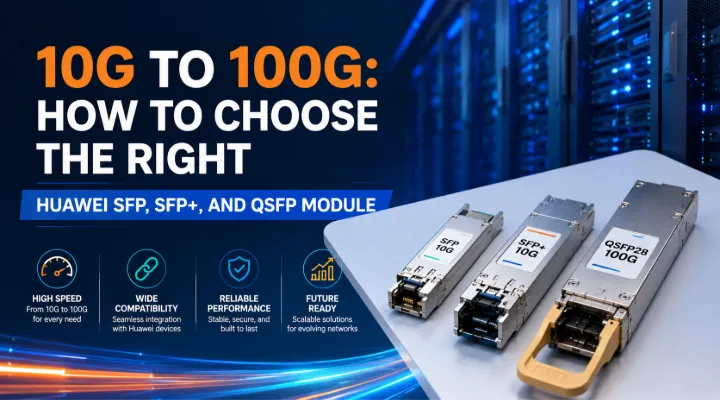
As organizations continue to expand their network infrastructure, selecting the right optical transceiver becomes increasingly important. Whether you are upgrading an enterprise network, expanding a data center, or deploying a high-speed backbone, choosing the correct Huawei optical module can significantly impact network performance, reliability, and scalability.
Huawei offers a comprehensive portfolio of optical transceivers, including SFP, SFP+, SFP28, QSFP+, and QSFP28 modules that support speeds ranging from 1G and 10G to 100G and beyond. However, many ICT buyers, network administrators, and IT decision-makers struggle to determine which module best suits their requirements.
Understanding the differences between these modules and knowing when to use each one can help organizations optimize their investments while ensuring future network growth.
This guide explains the key differences between Huawei SFP, SFP+, and QSFP modules and provides practical advice for selecting the right solution for your networking needs.
Who Should Read This Guide?
This article is designed for:
- ICT buyers
- Network engineers
- IT managers
- Data center administrators
- Telecom professionals
- Enterprise decision-makers
- System integrators
- Managed service providers
Whether you are building a new network or upgrading an existing one, this guide will help you make informed purchasing decisions.
Understanding Optical Transceivers
Optical transceivers are hot-swappable devices that connect networking equipment to fiber optic cabling. They convert electrical signals into optical signals for transmission and convert incoming optical signals back into electrical data.
These modules are commonly installed in:
- Switches
- Routers
- Firewalls
- Storage systems
- Servers
- Data center equipment
Without transceivers, fiber-based communication would not be possible.
Why Huawei Optical Modules Are Popular
Huawei has become one of the leading networking technology providers globally. Their optical modules are designed to deliver:
- High reliability
- Excellent compatibility
- Low power consumption
- Long transmission distances
- Enterprise-grade performance
- Support for modern networking standards
Huawei optical transceivers are widely used in:
- Enterprise networks
- Cloud environments
- Telecommunications
- Educational institutions
- Government networks
- Large-scale data centers
Understanding Huawei Optical Module Types
Huawei SFP Modules
What Is an SFP Module?
SFP stands for Small Form-Factor Pluggable.
These modules are primarily designed for Gigabit Ethernet applications and support speeds up to 1Gbps.
Common Applications
SFP modules are commonly used for:
- Access switches
- Enterprise LANs
- Security systems
- Campus networks
- Branch office connectivity
Advantages
- Affordable
- Compact design
- Easy deployment
- Low power consumption
Typical Distance Options
Huawei SFP modules support various ranges including:
- 550 meters
- 10 kilometers
- 20 kilometers
- 40 kilometers
- 80 kilometers
depending on the model and fiber type.
Huawei SFP+ Modules
What Is SFP+?
SFP+ is an enhanced version of the standard SFP module and supports speeds up to 10Gbps.
It uses a similar form factor but provides significantly higher bandwidth.
Common Use Cases
SFP+ modules are widely deployed for:
- Data center server connections
- Storage area networks
- Core network uplinks
- Virtualization environments
- Enterprise backbone networks
Key Benefits
- Ten times faster than 1G SFP
- Supports growing workloads
- Cost-effective 10G deployment
- Compatible with modern enterprise networks
Popular Huawei SFP+ Speeds
Typical Huawei SFP+ modules support:
- 10G SR (Short Range)
- 10G LR (Long Range)
- 10G ER (Extended Range)
These variants provide flexibility for different deployment scenarios.
Huawei SFP28 Modules
What Is SFP28?
SFP28 modules support 25Gbps connectivity.
They maintain the same compact form factor as SFP+ while delivering significantly higher bandwidth.
Why 25G Is Growing
Many modern data centers are moving from 10G to 25G because:
- Better performance
- Higher efficiency
- Lower cost per gigabit
- Improved scalability
Ideal Environments
SFP28 is commonly used for:
- Cloud infrastructure
- Enterprise data centers
- High-performance computing
- Storage networking
Huawei QSFP+ Modules
What Is QSFP+?
QSFP+ stands for Quad Small Form-Factor Pluggable Plus.
These modules support speeds up to 40Gbps.
Applications
QSFP+ modules are commonly used in:
- Core switching
- Data center aggregation
- Network backbones
- High-bandwidth applications
Advantages
- High-density connectivity
- Reduced cabling requirements
- Efficient use of switch ports
Huawei QSFP28 Modules
What Is QSFP28?
QSFP28 modules support 100Gbps Ethernet connectivity.
They are among the most widely used optical modules in modern data centers.
Common Applications
QSFP28 modules are ideal for:
- Hyperscale data centers
- Cloud providers
- AI environments
- Telecom networks
- High-speed enterprise cores
Key Benefits
- Massive bandwidth
- Improved network efficiency
- Future-ready infrastructure
- Lower cost per transmitted bit
Comparing Huawei Optical Modules
| Module Type | Speed | Typical Use |
|---|---|---|
| SFP | 1G | Access Layer |
| SFP+ | 10G | Enterprise Backbone |
| SFP28 | 25G | Data Centers |
| QSFP+ | 40G | Aggregation Layer |
| QSFP28 | 100G | Core & Data Centers |
This table provides a quick overview of where each module fits within a network architecture.
How to Choose the Right Huawei Optical Module
Step 1: Determine Your Required Speed
The first question to ask is:
How much bandwidth do you need today and in the future?
Choose SFP If:
- You only require 1G connectivity
- Budget is a major concern
- Existing infrastructure supports Gigabit Ethernet
Choose SFP+ If:
- You need 10G connectivity
- You are upgrading enterprise networks
- You require higher server performance
Choose SFP28 If:
- Your data center uses 25G networking
- You want better scalability
- You are preparing for future growth
Choose QSFP+ If:
- You need 40G backbone connectivity
- Multiple 10G links need consolidation
Choose QSFP28 If:
- You require 100G performance
- Your environment handles large data volumes
- You are building modern cloud infrastructure
Step 2: Evaluate Transmission Distance
Different optical modules support different transmission ranges.
Short-Range (SR)
Suitable for:
- Data centers
- Server rooms
- Campus buildings
Distance:
- Up to 300 meters depending on fiber type
Long-Range (LR)
Suitable for:
- Enterprise campuses
- Metro networks
Distance:
- Up to 10 kilometers
Extended-Range (ER)
Suitable for:
- Service providers
- Long-distance deployments
Distance:
- Up to 40 kilometers or more
Always match your distance requirements with the correct module specification.
Step 3: Select the Correct Fiber Type
Multi-Mode Fiber (MMF)
Best suited for:
- Short-distance links
- Data centers
- Enterprise buildings
Benefits:
- Lower initial cost
- Easier deployment
Single-Mode Fiber (SMF)
Best suited for:
- Long-distance communication
- Metro networks
- Telecom infrastructure
Benefits:
- Longer transmission distances
- Higher scalability
Using the wrong fiber type can cause connectivity problems and signal loss.
Step 4: Verify Device Compatibility
Before purchasing any optical module, verify compatibility with:
- Huawei switches
- Huawei routers
- Network operating systems
- Existing infrastructure
Compatibility checks help avoid deployment issues and unexpected costs.
Step 5: Consider Future Growth
Many organizations purchase modules based solely on current needs.
This approach often leads to expensive upgrades later.
Consider:
- Future bandwidth requirements
- Cloud migration plans
- AI workloads
- Expansion projects
- New applications
Investing in scalable solutions often delivers better long-term value.
Common Deployment Scenarios
Scenario 1: Small Business Network
Requirements:
- Basic connectivity
- Limited budget
- Moderate traffic
Recommended Module:
Huawei SFP 1G
Reason:
Provides cost-effective performance for everyday networking tasks.
Scenario 2: Enterprise Campus Upgrade
Requirements:
- Faster backbone
- Increased user traffic
- Improved application performance
Recommended Module:
Huawei SFP+ 10G
Reason:
Offers significant bandwidth improvements without major infrastructure changes.
Scenario 3: Data Center Expansion
Requirements:
- High-density server connectivity
- Cloud workloads
- Storage traffic
Recommended Module:
Huawei SFP28 25G
Reason:
Provides better performance and efficiency than traditional 10G deployments.
Scenario 4: Core Network Deployment
Requirements:
- High throughput
- Aggregation links
- Reduced congestion
Recommended Module:
Huawei QSFP+ 40G
Reason:
Supports growing network demands while maintaining efficiency.
Scenario 5: Modern Cloud Infrastructure
Requirements:
- Massive data transfer
- AI workloads
- High-performance computing
Recommended Module:
Huawei QSFP28 100G
Reason:
Delivers the bandwidth required for modern digital environments.
Benefits of Choosing Genuine Huawei Optical Modules
Using genuine Huawei optical modules provides several advantages.
Improved Reliability
- Consistent performance
- Reduced failure rates
- Better signal integrity
Manufacturer Support
- Warranty coverage
- Firmware compatibility
- Technical assistance
Better Network Stability
- Optimized performance
- Reduced downtime
- Enhanced security
Long-Term Cost Savings
- Lower maintenance costs
- Reduced replacement frequency
- Improved operational efficiency
Why Buy Huawei Optical Modules Through ICTECH Distribution
Choosing the right supplier is just as important as selecting the right module.
ICTECH Distribution helps businesses source genuine Huawei networking products and optical transceivers with professional guidance and technical support.
Benefits include:
- Access to Huawei networking solutions
- Expert consultation
- Competitive pricing
- Business-focused support
- Bulk procurement assistance
Whether you need 10G SFP+, 25G SFP28, 40G QSFP+, or 100G QSFP28 modules, ICTECH Distribution can help identify the best solution for your infrastructure requirements.
Conclusion
Selecting the right Huawei optical module is a critical decision that directly impacts network performance, scalability, and return on investment.
SFP modules are ideal for basic Gigabit networking, while SFP+ modules provide reliable 10G connectivity for enterprise environments. For modern data centers, SFP28 delivers efficient 25G performance, while QSFP+ and QSFP28 modules support demanding 40G and 100G applications.
By carefully evaluating speed requirements, transmission distance, fiber type, compatibility, and future growth plans, ICT buyers can make informed decisions that support long-term business objectives.
As organizations continue to embrace cloud computing, AI, and digital transformation, choosing the right Huawei optical transceiver today can help build a faster, more resilient network for tomorrow.
Frequently Asked Questions (FAQs)
1. What is the difference between Huawei SFP and SFP+ modules?
Huawei SFP modules support 1Gbps speeds, while SFP+ modules support up to 10Gbps and are commonly used in enterprise backbone networks.
2. When should I choose a QSFP28 module?
Choose QSFP28 when your network requires 100Gbps connectivity, particularly in data centers, cloud environments, and high-performance computing infrastructures.
3. Can SFP+ modules be used in SFP ports?
In most cases, SFP+ modules require SFP+ compatible ports. Compatibility depends on the network device specifications.
4. Which fiber type should I use with Huawei optical modules?
Multi-mode fiber is ideal for short distances, while single-mode fiber is recommended for long-distance communication and telecom applications.
5. Are Huawei optical transceivers suitable for enterprise networks?
Yes. Huawei optical modules are widely used in enterprise, telecom, campus, and data center environments due to their reliability, scalability, and performance.
