
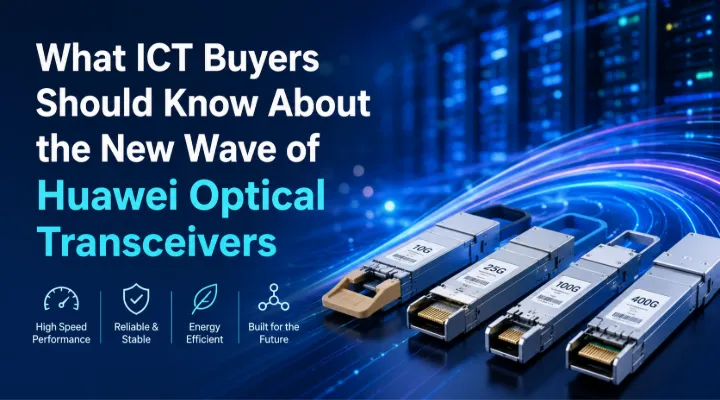
As businesses continue to expand their digital infrastructure, the demand for faster, more reliable, and more efficient network connectivity is growing rapidly. Whether it is a data center, enterprise campus, telecom network, cloud environment, or industrial deployment, optical transceivers play a critical role in ensuring seamless data transmission.
Huawei has become one of the leading technology providers in the networking industry, offering a wide range of optical transceivers designed to support modern network requirements. The latest generation of Huawei optical transceivers delivers higher speeds, lower power consumption, improved compatibility, and enhanced reliability.
For ICT buyers, understanding the capabilities and benefits of these new optical modules is essential when planning network upgrades or new deployments. Choosing the right transceiver can significantly impact network performance, scalability, operational costs, and future expansion possibilities.
This article explores the latest developments in Huawei optical transceivers, their key features, practical applications, and what ICT decision-makers should consider before making a purchase.
Understanding Optical Transceivers
An optical transceiver is a networking component that converts electrical signals into optical signals and vice versa. It allows network devices such as switches, routers, firewalls, servers, and storage systems to communicate through fiber optic cables.
Optical transceivers are commonly used in:
- Data centers
- Enterprise networks
- Telecommunications networks
- Cloud computing environments
- Campus networks
- Industrial communication systems
- Smart city infrastructure
They are available in multiple form factors and speed options to support various networking requirements.
Why Optical Transceivers Matter in Modern Networks
As organizations generate and process larger amounts of data, network infrastructure must evolve to support higher bandwidth requirements.
Modern workloads such as:
- Artificial Intelligence (AI)
- Machine Learning (ML)
- Cloud Computing
- Video Conferencing
- Remote Work Solutions
- Big Data Analytics
- Internet of Things (IoT)
require high-speed and low-latency network connectivity.
Optical transceivers serve as the foundation that enables these applications to operate efficiently.
The Evolution of Huawei Optical Transceivers
Huawei has continuously invested in optical networking technology. The latest generation of Huawei optical modules is designed to address challenges associated with increasing network traffic and growing bandwidth demands.
Compared to previous generations, newer Huawei transceivers offer:
- Higher transmission speeds
- Better energy efficiency
- Improved optical performance
- Longer transmission distances
- Enhanced compatibility
- Greater reliability
- Lower total cost of ownership
These improvements make them attractive for organizations looking to future-proof their network investments.
Key Trends Driving the New Wave of Huawei Optical Transceivers
Increasing Demand for High-Speed Connectivity
Network speeds have evolved significantly over the years.
Common network speeds now include:
| Generation | Speed |
|---|---|
| Gigabit Ethernet | 1G |
| 10 Gigabit Ethernet | 10G |
| 25 Gigabit Ethernet | 25G |
| 40 Gigabit Ethernet | 40G |
| 100 Gigabit Ethernet | 100G |
| 200 Gigabit Ethernet | 200G |
| 400 Gigabit Ethernet | 400G |
Huawei's latest optical transceivers support these higher-speed environments, helping organizations meet increasing performance requirements.
Growth of Cloud Data Centers
Cloud providers and enterprise data centers require massive bandwidth to support virtualization, storage systems, and cloud applications.
Huawei has introduced advanced optical modules designed specifically for:
- Spine-leaf architectures
- High-density switching environments
- Cloud-scale deployments
- Data center interconnects
These solutions help reduce bottlenecks while improving overall network efficiency.
AI and High-Performance Computing
Artificial intelligence workloads generate enormous amounts of data that must move quickly between servers and storage systems.
Huawei's latest optical transceivers help support:
- GPU clusters
- AI training environments
- Machine learning platforms
- HPC infrastructures
High-speed optical connectivity ensures data moves efficiently across these environments.
Popular Huawei Optical Transceiver Categories
SFP Optical Transceivers
SFP (Small Form-factor Pluggable) modules are widely used for Gigabit Ethernet applications.
Common use cases include:
- Access switches
- Enterprise networks
- Security systems
- Campus environments
Benefits include:
- Compact design
- Easy installation
- Cost-effective deployment
SFP+ Optical Modules
SFP+ transceivers support 10G networking and remain one of the most popular choices for enterprise networks.
Applications include:
- Server connectivity
- Switch uplinks
- Storage networks
- Data center connections
Advantages:
- High bandwidth
- Low latency
- Mature ecosystem
SFP28 Optical Transceivers
SFP28 modules provide 25G connectivity and are increasingly replacing older 10G infrastructure.
Benefits include:
- Better bandwidth utilization
- Lower power consumption
- Improved performance per port
Many modern data centers are adopting 25G as a standard server connection speed.
QSFP+ and QSFP28 Modules
These modules support:
- 40G networking
- 100G networking
They are commonly used in:
- Core networks
- Data centers
- Telecom environments
Huawei offers multiple variants to support different distances and deployment scenarios.
400G Optical Transceivers
One of the most significant developments in networking is the move toward 400G connectivity.
Huawei's 400G solutions help organizations:
- Increase network capacity
- Reduce cabling complexity
- Improve data center scalability
- Prepare for future workloads
These modules are becoming increasingly important for hyperscale environments.
Key Benefits of Huawei Optical Transceivers
High Reliability
Huawei optical modules undergo extensive testing before deployment.
This ensures:
- Stable network performance
- Reduced downtime
- Improved operational efficiency
Reliability is especially important for mission-critical environments.
Excellent Compatibility
One major concern for ICT buyers is compatibility.
Huawei designs its optical transceivers to work seamlessly with:
- Huawei switches
- Huawei routers
- Huawei data center solutions
Many modules also support interoperability across broader networking environments, depending on deployment requirements.
Lower Power Consumption
Power efficiency has become a major priority for modern data centers.
Huawei's latest transceivers offer:
- Reduced energy usage
- Lower cooling requirements
- Improved sustainability
This can significantly reduce operating expenses over time.
Long-Distance Transmission Support
Huawei offers optical modules capable of supporting:
- Short-range connections
- Medium-distance links
- Long-distance metropolitan networks
Distance options may range from a few meters to several kilometers depending on the module type.
Practical Deployment Examples
Example 1: Enterprise Campus Upgrade
A large university upgrades from a 1G network to a 10G backbone.
Using Huawei SFP+ optical modules:
- Network congestion decreases
- Video conferencing quality improves
- File transfer speeds increase
The institution experiences better user satisfaction while preparing for future growth.
Example 2: Data Center Expansion
A cloud service provider expands its data center.
By deploying Huawei 100G QSFP28 transceivers:
- Server communication becomes faster
- Storage access improves
- Overall network efficiency increases
The company supports more customers without redesigning its network architecture.
Example 3: Telecom Network Modernization
A telecommunications provider upgrades its infrastructure to support increasing subscriber demand.
Huawei high-speed optical modules help:
- Increase network capacity
- Improve service reliability
- Reduce operational complexity
The provider delivers better customer experiences while lowering maintenance costs.
Important Factors ICT Buyers Should Consider
1. Network Speed Requirements
Start by identifying your current and future bandwidth needs.
Questions to ask:
- Are you upgrading from 1G to 10G?
- Will 25G or 100G be required soon?
- Is 400G part of your long-term strategy?
Planning ahead can prevent costly upgrades later.
2. Transmission Distance
Different optical modules support different distances.
Examples:
- Short-range (SR)
- Long-range (LR)
- Extended-range (ER)
Always match the transceiver to the required fiber distance.
3. Fiber Type
Optical modules are designed for:
Single-Mode Fiber (SMF)
Best for:
- Long-distance transmission
- Metropolitan networks
- Telecom applications
Multi-Mode Fiber (MMF)
Best for:
- Short-distance connections
- Enterprise environments
- Data center deployments
Selecting the wrong fiber type can lead to performance issues.
4. Future Scalability
ICT buyers should think beyond immediate requirements.
Consider:
- Expected business growth
- Increasing application demands
- Cloud migration plans
- AI initiatives
Choosing scalable solutions reduces future replacement costs.
5. Total Cost of Ownership
The cheapest module may not always be the best option.
Evaluate:
- Power consumption
- Reliability
- Warranty support
- Maintenance requirements
- Network efficiency
A higher-quality transceiver often provides better long-term value.
Why Huawei Continues to Gain Attention in Optical Networking
Huawei has built a strong reputation in networking and telecommunications by focusing on innovation and performance.
Key strengths include:
- Broad product portfolio
- Advanced R&D capabilities
- High-speed optical technologies
- Energy-efficient designs
- Enterprise-grade reliability
- Data center expertise
- Global deployment experience
These factors make Huawei optical transceivers a preferred option for many ICT professionals.
How ICT Distribution Helps Buyers Source Huawei Solutions
Finding genuine optical transceivers from trusted suppliers is critical for ensuring performance and warranty support.
ICT buyers should work with experienced distributors that can provide:
- Product consultation
- Compatibility guidance
- Deployment recommendations
- Bulk procurement options
- Technical assistance
At ICTECH Distribution, businesses can access a wide range of networking solutions, including optical networking products, enterprise infrastructure components, and data center technologies designed to meet modern connectivity requirements.
Conclusion
The networking industry is entering a new era driven by cloud computing, AI workloads, data center expansion, and increasing bandwidth demands. As a result, optical transceivers have become more important than ever.
Huawei's latest generation of optical transceivers delivers significant improvements in speed, reliability, energy efficiency, and scalability. From 10G enterprise networks to 400G data center deployments, these modules help organizations build future-ready infrastructure capable of supporting evolving business requirements.
For ICT buyers, understanding factors such as speed, distance, fiber type, compatibility, and long-term scalability is essential when selecting optical transceivers. By making informed decisions today, organizations can create networks that remain efficient, reliable, and prepared for future growth.
Frequently Asked Questions (FAQs)
1. What is a Huawei optical transceiver?
A Huawei optical transceiver is a networking module that converts electrical signals into optical signals and vice versa, enabling data transmission over fiber optic cables.
2. What speeds do Huawei optical transceivers support?
Huawei offers optical transceivers supporting multiple speeds, including 1G, 10G, 25G, 40G, 100G, 200G, and 400G networking environments.
3. What is the difference between SFP+ and QSFP28 modules?
SFP+ modules typically support 10G connections, while QSFP28 modules are designed for 100G networking applications and higher-density environments.
4. How do I choose the right Huawei optical transceiver?
Consider factors such as network speed, transmission distance, fiber type, device compatibility, and future scalability requirements.
5. Are Huawei optical transceivers suitable for data centers?
Yes. Huawei offers a wide range of optical transceivers specifically designed for modern data centers, cloud environments, and high-performance networking applications.
