
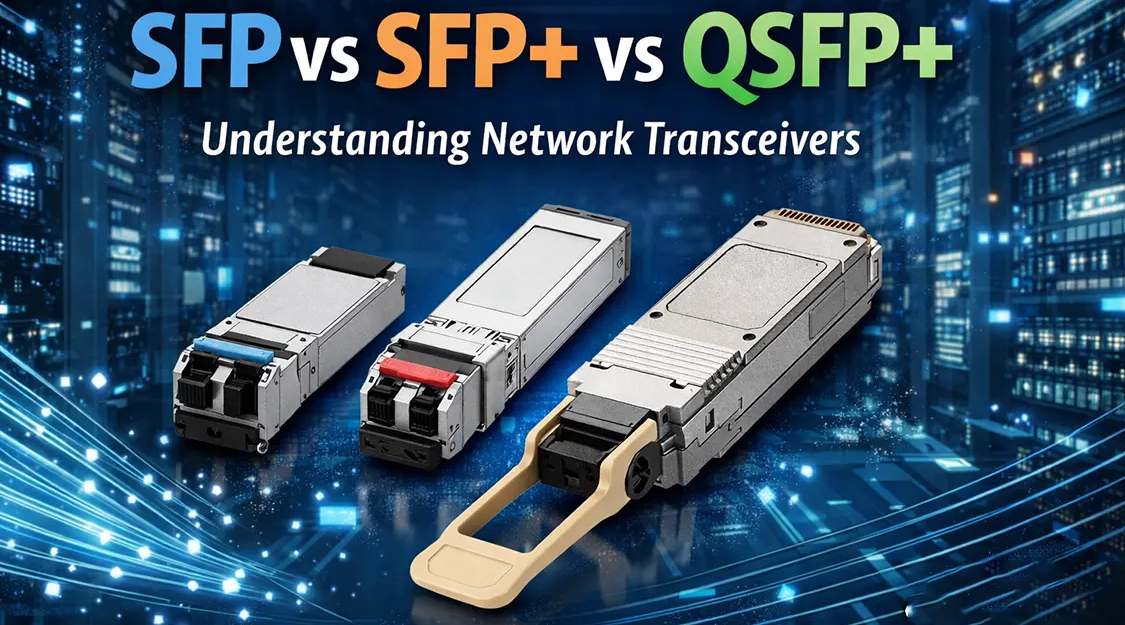
Modern enterprise networks and data centers rely heavily on high-speed, flexible connectivity. As bandwidth demands grow due to cloud computing, virtualization, AI workloads, and large-scale storage, network hardware must support faster and more scalable data transmission. This is where pluggable optical transceivers such as SFP, SFP+, and QSFP+ play a critical role.
These compact modules enable switches, routers, servers, and storage systems to connect using fiber optic or copper cables while allowing organizations to choose the right speed, distance, and media type for their infrastructure.
This blog explains what SFP, SFP+, and QSFP+ modules are, how they differ, and how newer transceiver standards are shaping modern networks. Businesses sourcing networking equipment through trusted suppliers such as ICTECH Distribution can benefit from understanding these technologies before making purchasing decisions.
What Are Pluggable Transceivers?
Pluggable transceivers are small hardware modules that insert into dedicated ports on networking equipment. Their primary function is to convert electrical signals from a device into optical or copper signals for data transmission and then convert incoming signals back into electrical form.
The advantage of pluggable transceivers is flexibility. Instead of buying switches with fixed ports, organizations can select transceivers based on speed, distance, and cable type, making network upgrades and expansions more cost-effective.
What Is SFP (Small Form-factor Pluggable)?
SFP is one of the earliest widely adopted pluggable transceiver standards and is still used in many enterprise networks.
SFP modules typically support data speeds of up to 1 Gbps. They are commonly found in access switches, older server NICs, and basic enterprise networking environments.
SFP modules support both fiber and copper connections. Fiber SFPs are available for multimode and single-mode fiber, while copper SFPs support short-range Ethernet connections. Depending on the model, SFP modules can support distances ranging from a few meters to over 10 kilometers.
Despite being a legacy standard, SFP remains relevant for organizations maintaining existing infrastructure or deploying cost-efficient gigabit networks.
What Is SFP+?
SFP+ is an enhanced version of the original SFP standard, designed to support higher bandwidth requirements.
SFP+ modules operate at speeds of up to 10 Gbps and are widely used in data centers, enterprise core networks, and server-to-switch connections. One of the major advantages of SFP+ is that it maintains the same physical size as SFP while delivering ten times the bandwidth.
SFP+ supports direct attach copper cables for short-range connections as well as fiber optic modules for longer distances. These characteristics make SFP+ ideal for high-performance, low-latency networking environments.
Many modern switches are backward compatible, allowing SFP ports to accept SFP modules while dedicated SFP+ ports are used for higher-speed links.
What Is QSFP+?
QSFP+ stands for Quad Small Form-factor Pluggable Plus and is designed for significantly higher throughput.
QSFP+ modules deliver a total bandwidth of 40 Gbps by combining four 10 Gbps lanes into a single transceiver. One of their most useful features is breakout capability, which allows a single QSFP+ port to be split into four independent 10 Gbps SFP+ connections.
QSFP+ modules are commonly deployed in data center aggregation layers, spine-leaf architectures, and high-performance computing environments. They enable high port density while reducing cable clutter and power consumption.
Beyond QSFP+: Newer Transceiver Standards
As network speeds continue to increase, newer transceiver standards have emerged to meet modern performance requirements.
SFP28 modules support 25 Gbps and are commonly used in server network interface cards and top-of-rack switches. QSFP28 extends this concept further by delivering 100 Gbps using four 25 Gbps lanes and has become a standard choice for modern data center cores.
At the high end, QSFP-DD modules support speeds of up to 400 Gbps and are primarily used in hyperscale data centers, AI clusters, and cloud service provider networks.
While older form factors such as CFP and CFP2 were once popular, they are now largely replaced by QSFP-based solutions due to better efficiency and smaller size.
Choosing the Right Transceiver for Your Network
Selecting the right transceiver depends on several factors, including network speed requirements, distance, device compatibility, and future scalability.
Enterprise IT teams must also consider power consumption, latency, and total cost of ownership. Working with an experienced IT hardware distributor ensures compatibility and access to genuine, tested networking components.
ICTECH Distribution supplies a wide range of networking and data center products, including switches, servers, storage, and compatible transceiver modules for enterprise and large-scale deployments. Their expertise helps organizations design reliable and scalable network infrastructures using the right optical and copper solutions.
Why Transceiver Knowledge Matters for B2B Buyers
Understanding transceiver standards is essential for IT managers, system integrators, and procurement teams. Incorrect module selection can lead to compatibility issues, limited performance, or unnecessary expenses.
By choosing the right SFP, SFP+, QSFP+, or next-generation transceivers, businesses can improve network efficiency, reduce downtime, and prepare their infrastructure for future growth.
With trusted sourcing from ICTECH Distribution, organizations can confidently deploy enterprise-grade networking solutions that meet performance and reliability expectations.
Frequently Asked Questions (Q&A)
1. Can SFP and SFP+ modules be used in the same switch?
Yes, many switches support both SFP and SFP+ ports. However, SFP modules operate at 1 Gbps, while SFP+ modules operate at 10 Gbps, and they must be used in compatible ports.
2. What is the difference between QSFP+ and QSFP28?
QSFP+ supports 40 Gbps using four 10 Gbps lanes, while QSFP28 supports 100 Gbps using four 25 Gbps lanes. QSFP28 is more common in modern data center environments.
3. Are fiber transceivers better than copper?
Fiber transceivers are better for long distances, higher speeds, and lower latency. Copper is typically used for short distances due to lower cost and ease of installation.
4. Can QSFP+ ports be split into multiple connections?
Yes, QSFP+ supports breakout cables that allow one 40 Gbps port to be split into four 10 Gbps SFP+ connections, depending on switch support.
5. Why buy transceivers from an authorized distributor?
Buying from trusted distributors like ICTECH Distribution ensures compatibility, quality assurance, warranty support, and access to enterprise-grade networking hardware
