
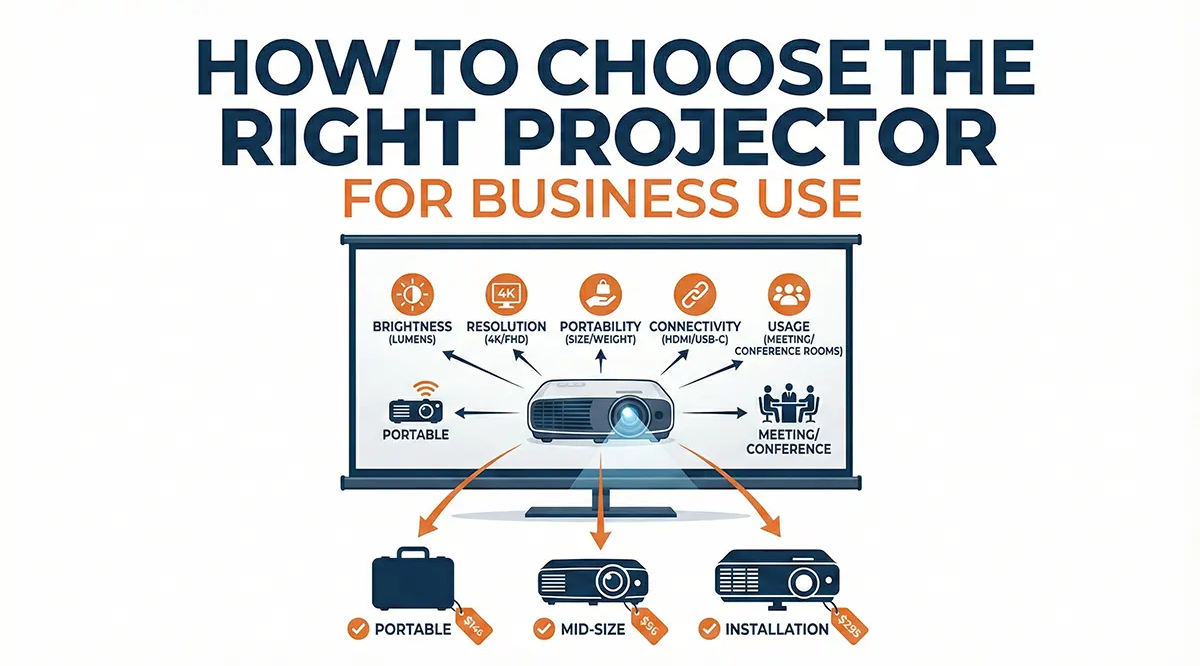
Choosing the right projector for business is no longer just about displaying slides on a wall. Modern workplaces rely on projectors for presentations, training sessions, video conferencing, digital signage, and even collaborative workspaces. With many technologies and specifications available, selecting the correct projector can directly impact productivity, professionalism, and long-term cost efficiency.
This guide explains the key factors you should consider when choosing a business projector and how organizations can make a smart investment that suits their operational needs. ICTECH Distribution works with enterprises, system integrators, and resellers to supply business-grade projection solutions suitable for a wide range of corporate environments.
Understand Your Business Use Case
The first step in choosing a projector is defining how it will be used. Different business environments demand different projector capabilities.
Boardrooms typically require high-resolution projectors with sharp text clarity and accurate colors. Training rooms often need higher brightness to handle ambient light and larger screen sizes. Auditoriums or conference halls require powerful projectors with long-throw lenses and advanced image processing. Retail or signage applications may prioritize durability and continuous operation.
By identifying whether the projector is for presentations, video playback, hybrid meetings, or large-scale events, businesses can narrow down the most suitable category.
Brightness Matters More Than You Think
Brightness is measured in lumens and is one of the most important specifications for business projectors. Offices and meeting rooms usually have ambient lighting that cannot be completely controlled, so insufficient brightness leads to washed-out images.
Small meeting rooms generally need around 3,000 to 4,000 lumens. Medium-sized conference rooms benefit from 4,500 to 6,000 lumens. Large halls or well-lit environments may require 7,000 lumens or more.
Choosing higher brightness than the minimum requirement ensures consistent visibility and flexibility across different rooms. ICTECH Distribution commonly recommends slightly higher lumen ratings for corporate customers to future-proof installations.
Resolution and Image Quality
Resolution defines how sharp and detailed the projected image appears. For business use, clarity of text, charts, and spreadsheets is critical.
Full HD (1920 x 1080) is suitable for most corporate presentations and video content. WUXGA (1920 x 1200) is preferred in professional environments because it offers extra vertical space, making it easier to display spreadsheets and documents. For premium boardrooms or design-focused teams, 4K projectors deliver exceptional detail but come at a higher cost.
Higher resolution also reduces eye strain during long presentations and improves the overall professional appearance.
Choose the Right Projection Technology
Business projectors mainly use three technologies: DLP, LCD, and laser-based systems.
DLP projectors are known for sharp images and reliable performance, making them popular in conference rooms. LCD projectors generally offer better color brightness, which is useful for presentations with graphics and branding elements. Laser projectors are increasingly preferred for businesses because they provide long life spans, low maintenance, instant on/off functionality, and consistent brightness over time.
While lamp-based projectors have lower upfront costs, laser projectors often deliver better long-term value, especially for frequent use.
Throw Distance and Installation Flexibility
Throw distance refers to how far the projector must be from the screen to produce a desired image size. Understanding room dimensions is essential.
Standard throw projectors work well in larger rooms. Short-throw and ultra-short-throw projectors are ideal for small meeting rooms, as they can project large images from a very short distance. These also reduce shadows and glare, which is helpful for interactive presentations.
Ceiling-mounted installations may require lens shift and zoom features to fine-tune alignment without physically moving the projector. ICTECH Distribution often assists businesses in selecting models that match their room layouts and mounting preferences.
Connectivity and Compatibility
Modern business projectors must support multiple connectivity options. HDMI is essential, but additional ports such as USB, DisplayPort, and LAN add flexibility. Wireless projection is increasingly important for BYOD environments, allowing employees to present directly from laptops, tablets, or smartphones.
Network-enabled projectors allow centralized management, remote monitoring, and firmware updates, which is valuable for IT teams managing multiple meeting rooms.
Compatibility with video conferencing systems and collaboration platforms is another factor that businesses should not overlook.
Audio, Noise, and Operational Comfort
While most business environments use external sound systems, built-in speakers can be useful for small rooms or temporary setups. Noise level is another consideration, as loud fan noise can distract during meetings. Business-grade projectors are designed to operate quietly, especially in eco or standard modes.
Heat management and ventilation are also important for continuous operation, particularly in training centers or command rooms.
Total Cost of Ownership
Price should not be the only deciding factor. Businesses should evaluate the total cost of ownership, including lamp replacement, maintenance, energy consumption, and lifespan.
Laser projectors typically have higher initial costs but lower operating expenses due to longer life and minimal maintenance. Choosing a reliable distributor like ICTECH Distribution ensures access to genuine products, warranty support, and long-term availability.
Scalability and Future Needs
A good business projector should be scalable and adaptable. As organizations grow, meeting spaces may be upgraded, or usage may increase. Choosing projectors with higher brightness, advanced connectivity, and network management ensures they remain relevant for years.
Standardizing projector models across offices also simplifies maintenance and training.
Role of a Professional IT Distributor
Working with an experienced IT distributor helps businesses avoid costly mistakes. ICTECH Distribution supports enterprises by offering a wide portfolio of business projectors, technical consultation, and reliable supply chains. This ensures organizations select projectors that align with their operational requirements rather than just specifications on paper.
Frequently Asked Questions (Q&A)
1. What brightness level is best for a business projector?
For most offices, 4,000 to 6,000 lumens is ideal. Larger or brighter spaces may need higher lumen ratings.
2. Is a laser projector better than a lamp-based projector for business?
Yes, laser projectors generally offer longer lifespan, lower maintenance, and consistent performance, making them suitable for frequent business use.
3. Which resolution is recommended for corporate presentations?
Full HD is sufficient for most uses, but WUXGA is preferred for professional environments with detailed documents.
4. Are short-throw projectors good for small meeting rooms?
Yes, short-throw and ultra-short-throw projectors are excellent for small spaces and reduce shadows and glare.
5. Why should businesses buy projectors from an IT distributor instead of retail?
An IT distributor like ICTECH Distribution provides business-grade models, technical guidance, warranty support, and scalable supply for enterprise needs.
Choosing the right business projector is a strategic decision that affects communication, collaboration, and professional presentation. By focusing on real-world usage, long-term value, and expert sourcing through ICTECH Distribution, businesses can invest confidently in projection solutions that support growth and efficiency.
